
Explore India’s pivotal Business Responsibility and Sustainability Report (BRSR), understanding its 9 core principles, how it’s shaping corporate accountability, and why it’s crucial for sustainable growth in the Indian market.
India, a rapidly developing economic powerhouse, is making significant strides in integrating sustainability into its corporate framework. At the forefront of this movement is the Business Responsibility and Sustainability Report (BRSR), a mandatory reporting standard introduced by the Securities and Exchange Board of India (SEBI). The BRSR represents a fundamental shift from voluntary disclosures to a more structured, comprehensive, and outcome-oriented approach to ESG reporting for Indian companies.
This blog post will delve into the essence of the BRSR, its genesis, and a broad exploration of its nine core principles, highlighting why it’s not just a compliance requirement but a roadmap for sustainable and responsible business practices in India and beyond.
The Genesis of BRSR: A Leap Towards Responsible Business
For years, India had the Business Responsibility Report (BRR), a voluntary framework for non-financial reporting. However, with increasing global investor focus on ESG, mounting environmental challenges, and a growing emphasis on social equity, SEBI recognized the need for a more robust and granular reporting mechanism.
Introduced in 2021, the BRSR became mandatory for the top 1,000 listed companies by market capitalization from the financial year 2022-23. The BRSR is designed to provide stakeholders with a clear, comparable, and comprehensive understanding of a company’s performance on ESG parameters, pushing companies to think beyond mere financial returns and consider their broader impact on society and the environment.
The Nine Principles: A Holistic Framework for Responsible Conduct
The BRSR is structured around nine core principles of the National Guidelines on Responsible Business Conduct (NGRBCs), which itself draws inspiration from international frameworks like the UN Guiding Principles on Business and Human Rights. These principles offer a holistic view of what responsible business entails, covering environmental stewardship, ethical governance, and social responsibility.
Let’s explore each principle in broad detail:
Principle 1: Businesses should conduct and govern themselves with integrity and in a manner that is Ethical, Transparent and Accountable.
This principle lays the foundation for all responsible business conduct. It emphasizes the importance of a strong ethical culture, transparency in operations, and clear accountability mechanisms.
- Key aspects: Ethical leadership, anti-corruption policies, robust grievance redressal mechanisms, and transparent communication with all stakeholders.
- BRSR Focus: Requires companies to disclose their anti-corruption policies, details of any fines or penalties related to bribery/corruption, and mechanisms for ethical oversight.
Principle 2: Businesses should provide goods and services in a manner that is sustainable and safe.
This principle focuses on product stewardship, ensuring that offerings are not only safe for consumers but also produced and delivered in an environmentally and socially sustainable manner throughout their lifecycle.
- Key aspects: Product quality and safety, sustainable sourcing of raw materials, responsible marketing, customer feedback mechanisms, and minimizing environmental impact of products/services.
- BRSR Focus: Asks for information on product recalls, consumer complaints, and initiatives related to sustainable packaging, product design, and responsible advertising.
Principle 3: Businesses should promote the well-being of all employees, including those in their value chains.
This principle is central to social responsibility, emphasizing fair labor practices, employee well-being, and safe working conditions. It extends this responsibility beyond direct employees to those in a company’s value chain (e.g., contract workers, supply chain employees).
- Key aspects: Fair wages, safe and healthy workplaces, non-discrimination, freedom of association, skill development, employee grievance mechanisms, and policies against forced or child labor.
- BRSR Focus: Requires disclosures on employee turnover, gender diversity, minimum wages, employee benefits, parental leave, and training programs, with separate reporting for permanent and contractual workers.
Principle 4: Businesses should respect the interests of and be responsive to all their stakeholders.
This principle underscores the importance of stakeholder engagement, recognizing that a business’s success is intertwined with the well-being of its various stakeholders (e.g., employees, customers, suppliers, local communities, investors).
- Key aspects: Identifying key stakeholders, establishing formal channels for engagement, addressing stakeholder concerns, and integrating their feedback into decision-making processes.
- BRSR Focus: Mandates companies to list their stakeholder groups and details of engagements with them, ensuring a broad consultative approach.
Principle 5: Businesses should respect and promote human rights.
A fundamental principle, this requires businesses to respect internationally recognized human rights and avoid complicity in human rights abuses. This extends to their own operations and throughout their value chains.
- Key aspects: Human rights due diligence, policies against discrimination, harassment, and forced labor, providing access to remedy for affected individuals.
- BRSR Focus: Requires disclosures on human rights policies, training on human rights, and any reported instances of human rights violations.
Principle 6: Businesses should respect and make efforts to protect and restore the environment.
This principle is at the core of environmental stewardship, urging businesses to minimize their negative environmental impact and contribute positively to environmental protection.
- Key aspects: Resource efficiency, pollution prevention, waste management, circular economy practices, biodiversity protection, climate change mitigation (e.g., GHG emissions reduction), and adaptation.
- BRSR Focus: Demands detailed reporting on energy consumption, water withdrawal, GHG emissions (Scope 1, 2, and 3), waste generation, plastic waste, and initiatives for environmental protection and restoration.
Principle 7: Businesses, when engaging in influencing public and regulatory policy, should do so in a responsible and transparent manner.
This principle addresses lobbying and political engagement, emphasizing that such activities should be conducted ethically, transparently, and in alignment with public interest.
- Key aspects: Disclosure of lobbying activities, political donations, and ensuring that influence is not exerted to undermine responsible business conduct.
- BRSR Focus: Asks for details on the company’s public policy advocacy and any political contributions made.
Principle 8: Businesses should promote inclusive growth and equitable development.
This principle goes beyond minimizing harm to actively contributing to societal development, particularly for marginalized and vulnerable groups. It encourages businesses to be a force for good in their communities.
- Key aspects: Community development programs, local employment generation, promoting access to essential services, supporting small and medium enterprises (SMEs) in the value chain, and addressing socio-economic disparities.
- BRSR Focus: Requires reporting on CSR activities, initiatives for socio-economic development, and engagement with local communities.
Principle 9: Businesses should engage with and provide value to their consumers responsibly.
This final principle circles back to consumers, focusing on fair practices, product safety, data privacy, and ethical consumer engagement.
- Key aspects: Transparent pricing, responsible advertising, protection of consumer data, grievance redressal mechanisms, and ensuring products/services meet consumer needs responsibly.
- BRSR Focus: Asks for disclosures on customer complaints, data privacy policies, and initiatives for product safety and sustainable consumption.
The BRSR’s Impact and the Road Ahead
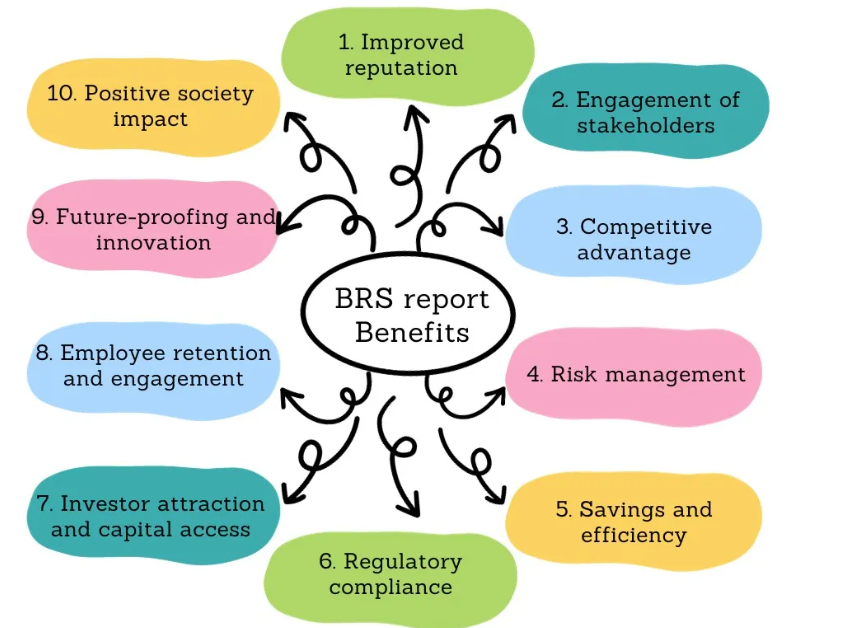
The BRSR is more than just a reporting format; it is a transformative tool for Indian corporate governance. By mandating detailed disclosures across these nine principles, it compels companies to:
- Integrate ESG: Embed sustainability into core business strategy, not just as a periphery activity.
- Improve Data Collection: Enhance internal systems for tracking and managing ESG data.
- Increase Accountability: Hold themselves accountable to stakeholders for their social and environmental performance.
- Enhance Comparability: Provide a standardized framework for investors to compare companies’ ESG performance.
As India continues its rapid economic expansion, the BRSR positions its leading companies to be not only financially robust but also socially responsible and environmentally conscious—a critical combination for long-term, sustainable growth in the 21st century. Its alignment with global ESG reporting trends also helps Indian companies meet the expectations of international investors and partners.