
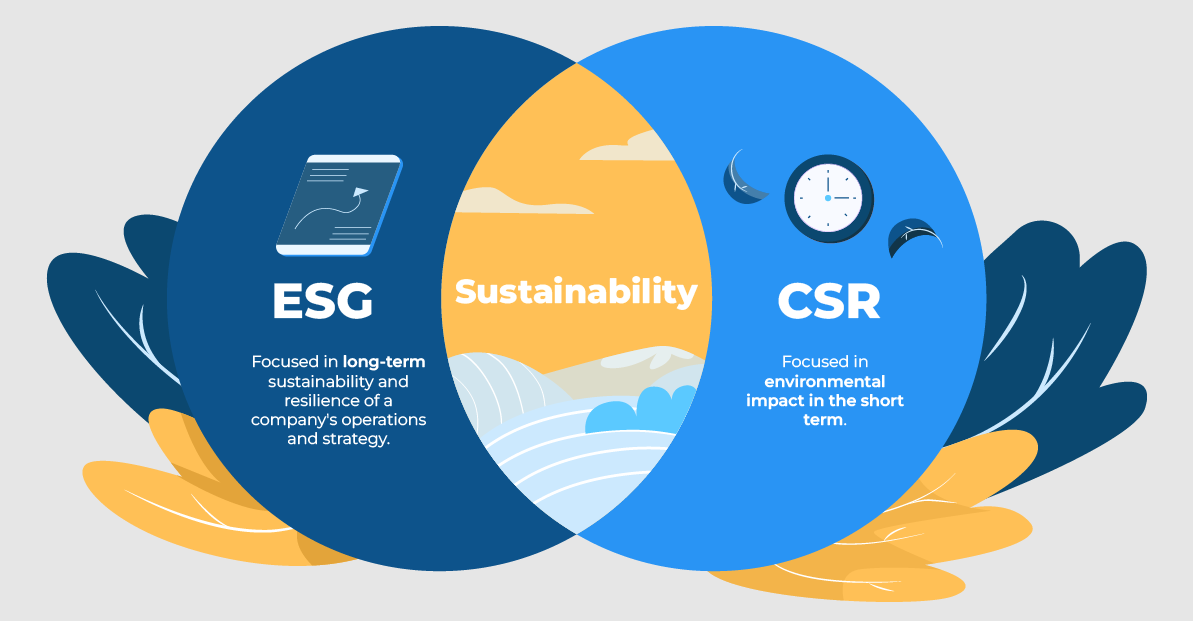
The world of corporate responsibility is evolving rapidly. A decade ago, Corporate Social Responsibility (CSR) was the definitive buzzword. Today, the conversation is dominated by Environmental, Social, and Governance (ESG). While both acronyms are vital to responsible business, they represent fundamentally different approaches, motivations, and, crucially, measurements.
Understanding the difference between CSR and ESG is no longer academic—it is essential for business leaders, investors, and consumers who want to know if a company is merely doing good (CSR) or if it is sustainable and well-governed for the long term (ESG).
This post will break down the core distinctions, helping you move from a broad focus on corporate values to a strategic, data-driven approach to sustainability.
What is Corporate Social Responsibility (CSR)? 🤝
CSR is the company’s internal compass and commitment to ethical conduct.
Corporate Social Responsibility (CSR) refers to a company’s voluntary, self-regulated initiatives and strategies that aim to contribute to societal goals, often by engaging in or supporting altruistic or ethical practices. Think of CSR as a company’s way of “giving back” and expressing its values.
- Focus & Scope: Broader, often philanthropic, and driven by a company’s internal values and desire to build a positive brand image and goodwill.
- Key Activities:
- Corporate volunteering and employee engagement programs.
- Donating a percentage of profits to charities or non-profits.
- Implementing ethical sourcing and fair labor practices (e.g., in the supply chain).
- High-level commitments like “reducing our carbon footprint.”
- Measurement: Generally qualitative and descriptive. Success is often measured by output (e.g., number of volunteer hours, amount donated, impact stories).
- Target Audience: Primarily employees, customers, and the local community.
- Voluntary vs. Mandatory: Predominantly voluntary, though some countries (like India) mandate a percentage of profit be spent on CSR activities.
Example: A tech company hosts an annual day for employees to plant trees and donates funds to a local school. This is a clear expression of a social and environmental commitment.
What is Environmental, Social, and Governance (ESG)? 📊
ESG is the investor’s framework for measuring risk, resilience, and long-term value creation.
Environmental, Social, and Governance (ESG) is a set of quantifiable criteria used by investors and stakeholders to assess a company’s overall sustainability and ethical performance. It moves beyond what a company says it values (CSR) to how well it manages specific, measurable sustainability risks and opportunities that can impact its financial performance.
The “E,” “S,” and “G” are distinct pillars:
| Pillar | Focus | Key Metrics/Examples |
| Environmental (E) | A company’s impact on the natural world. | Carbon emissions (Scope 1, 2, 3), water usage intensity, waste management, and renewable energy adoption. |
| Social (S) | How a company manages relationships with people. | Labor standards, diversity & inclusion, employee health and safety, data privacy, and community relations. |
| Governance (G) | A company’s leadership, ethics, and control mechanisms. | Board diversity and structure, executive compensation, anti-corruption policies, and transparent financial reporting. |
- Focus & Scope: Specific, financially material risks and opportunities, driven by external investor and regulatory demands for accountability and risk management.
- Key Activities: Integrating E, S, and G factors into core business strategy and operations.
- Measurement: Highly quantitative and data-driven. Success is measured by performance metrics (KPIs) against standardized frameworks (e.g., GHG reduction targets, percentage of women in leadership).
- Target Audience: Primarily investors, regulators, lenders, and ratings agencies.
- Voluntary vs. Mandatory: Increasingly mandatory and regulated (e.g., in the EU and for large listed companies globally).
Example: An asset manager evaluates the tech company based on its year-over-year reduction in Scope 1 and 2 emissions, the gender balance of its board, and its score on a third-party labor rights audit. This is a measurable assessment of performance and risk.
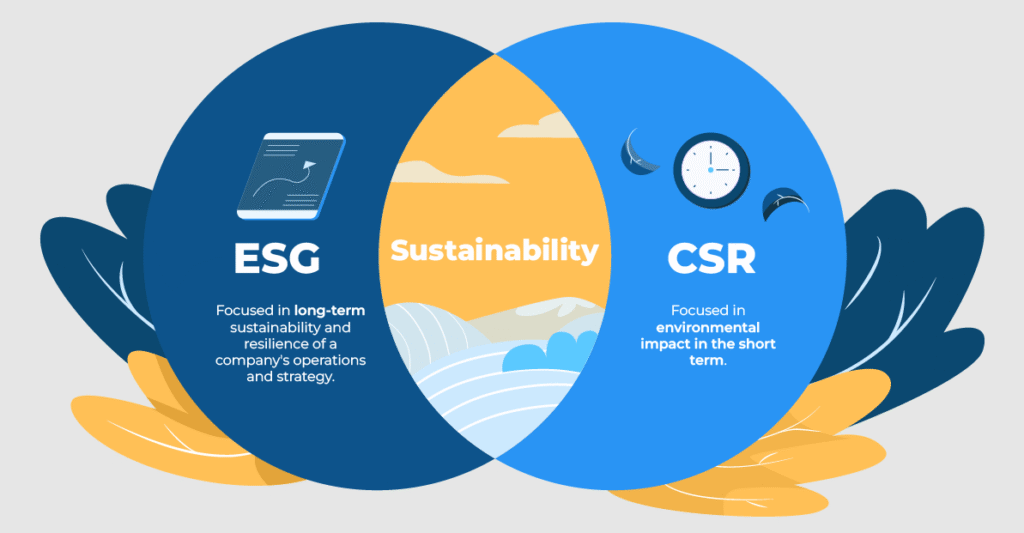
The Crucial Differences Summarized 🎯
While CSR and ESG share the goal of responsible business, their execution and impact differ across several dimensions.
| Feature | Corporate Social Responsibility (CSR) | Environmental, Social, and Governance (ESG) |
| Primary Driver | Internal values, ethics, and corporate culture. | External investor and stakeholder demand for data-driven assessment and risk management. |
| Reporting Style | Qualitative, narrative-heavy, and descriptive (e.g., case studies, stories). | Quantitative, metric-driven, and standardized (e.g., data points, scores, compliance forms). |
| Goal | To DO GOOD – build reputation, enhance brand loyalty, and give back to society. | To MEASURE GOODNESS – assess financial risk, long-term resilience, and non-financial performance. |
| Focus | Broad, often philanthropic and reactive to societal issues. | Specific, material risks and opportunities integrated into core business strategy. |
| Scope | Often focused on activities outside the core business (e.g., donations, volunteering). | Focused on performance within the core business (e.g., energy use in operations, board structure). |
Why Both Are Necessary for the Modern Business
The common misconception is that ESG has replaced CSR. In reality, they are complementary forces that work together for holistic sustainability:
- CSR creates the culture: CSR initiatives are crucial for instilling a culture of purpose, ethics, and social responsibility among employees, which is the necessary bedrock for any successful sustainability program.
- ESG provides the strategy and data: ESG takes those ethical intentions and translates them into measurable metrics, providing the hard data needed to manage risk, attract capital, and demonstrate long-term viability to the external world.
CSR is the heart of a responsible company—it defines the why. ESG is the head—it measures the how and drives strategic decisions. Businesses that successfully integrate both their ethical commitments (CSR) with a robust, data-driven performance framework (ESG) are best positioned for success in the sustainable economy of the future.